Whey Isolate vs Concentrate vs Hydrolysate: Which One Should You Actually Buy?
Whey isolate, concentrate, and hydrolysate are three forms of the same milk protein, separated by how heavily they’ve been filtered. Concentrate is the least processed (70-80% protein). Isolate is filtered further to remove most of the lactose and fat (90-95% protein). Hydrolysate is enzymatically pre-digested so the body absorbs it faster. The differences between them are real but mostly small. For 80% of lifters, isolate is the right pick. For the other 20%, concentrate is fine and saves money. Hydrolysate is rarely worth the price.
Here’s the honest version most articles skip.
TL;DR: Pick your protein in 30 seconds
Skip the chart hunting. Here’s the call:
- Lactose intolerant or sensitive? → Isolate. Concentrate will mess with your stomach.
- Cutting / watching every calorie? → Isolate. Fewer carbs and fat per scoop.
- Tight budget, no digestive issues? → Concentrate. Same amino acids, $5-15/tub cheaper.
- Post-surgery, gut recovery, or compete in fast-twitch sports? → Hydrolysate, if you can afford it. Otherwise isolate.
- Have no idea what your body tolerates? → Start with isolate. It works for everyone.
That covers most decisions. The rest of the article is for people who want to understand why.
What “whey” actually is
Whey is the watery part of milk that separates out during cheesemaking. You’ve seen it: that thin liquid sitting on top of yogurt when you open it. For decades, cheese factories considered whey a waste product and dumped it. Then someone figured out it was about 20% protein with one of the best amino acid profiles in human nutrition, and the supplement industry was born.
Cow’s milk is roughly 80% casein and 20% whey by protein content. Casein is the slow-digesting protein that gets used for nighttime products. Whey is the fast-digesting one that gets used for post-workout shakes. Both are complete proteins (all nine essential amino acids) but they behave differently once you drink them.
This article is about whey specifically, and the three forms it gets sold in.
The three forms, explained
The only meaningful difference between isolate, concentrate, and hydrolysate is how much filtering and processing they’ve been through.
Whey protein concentrate (WPC)
The least processed form. Manufacturers take liquid whey and run it through a basic filtration process that removes water and some carbs. What’s left is 70-80% protein, with the remaining 20-30% being a mix of lactose, fat, and some bioactive compounds (immunoglobulins, lactoferrin, growth factors) that some people argue are health benefits.
Per 30g scoop, you typically get:
- 22-24g protein
- 2-4g carbs (mostly lactose)
- 1-3g fat
- Roughly 130 calories
Cost: Cheapest form. Usually $15-25 per pound.
Taste: Creamier, richer, more “milky” because of the residual fat.
Whey protein isolate (WPI)
Concentrate that’s been run through a second round of more aggressive filtration. Microfiltration or ion exchange removes most of the lactose, fat, and other non-protein components. What’s left is 90-95% pure protein.
Per 30g scoop, you typically get:
- 25-27g protein
- 0-1g carbs
- 0-1g fat
- Roughly 110 calories
Cost: Mid-tier. Usually $20-35 per pound.
Taste: Cleaner, slightly less rich. Some find it chalky if the brand cuts corners on flavor.
The big advantage: Less than 1% lactose. If dairy makes you bloat or gives you gas, isolate is the form you want.
Whey protein hydrolysate (WPH)
Isolate (or concentrate) that’s been enzymatically broken down before it ever hits your stomach. Manufacturers use proteolytic enzymes to chop the long protein chains into shorter peptide chains and free amino acids. The result is a protein that’s essentially “pre-digested.”
Per 30g scoop, similar macros to isolate.
Cost: Most expensive. Often $35-60+ per pound.
Taste: Bitter. Hydrolysate is genuinely unpleasant on its own, which is why brands flavor it heavily.
The pitch: Faster absorption, slightly elevated muscle protein synthesis, easier on the stomach.
The reality: Research shows the absorption advantage is real but small. A 2009 study in the Journal of Applied Physiology compared whey hydrolysate to casein and soy isolate and found the fast-digesting proteins (whey hydrolysate and soy isolate) produced ~93% more muscle protein synthesis than slow-digesting casein. But the comparison to regular whey isolate? Studies have found “no difference in the pattern of aminoacidemia following ingestion of 36g of whole whey protein or its hydrolysate.” Translation: hydrolysate beats casein, but doesn’t meaningfully beat plain isolate.
The amino acid argument (and why it mostly doesn’t matter)
If you’ve read the comparison articles before, you’ve probably seen this argument: isolate has slightly more protein per gram, therefore slightly more leucine, therefore slightly better for muscle building.
It’s technically true. Per 25g scoop, isolate has about 2.7-3g of leucine. Concentrate has about 2.3-2.6g. Both clear the 2-3g threshold that triggers muscle protein synthesis (MPS), which is what actually matters.
A 2025 review in SAGE journals examined whey chemistry and MPS effects across studies and found that isolate produces slightly higher MPS than concentrate because of faster digestion. But the word slightly is doing real work in that sentence. The difference is measurable in a lab. It’s not measurable in your physique six months from now.
Here’s the part the supplement industry doesn’t lead with: total daily protein intake matters more than whey type by an order of magnitude. If you’re hitting 1.6-2.2g of protein per kg of bodyweight per day from a mix of whole foods and supplements, the isolate-vs-concentrate question is in the bottom 5% of variables affecting your results.
The amino acid argument is real and small. Don’t let it drive a $20 price difference.
When isolate is the obvious pick
There’s a specific kind of lifter for whom isolate is the right call and there’s no argument:
You’re lactose intolerant or sensitive. This is the biggest one. Concentrate contains 3-7g of lactose per serving. Isolate contains under 1g. If dairy makes you bloat, fart, get cramps, or feel generally off after a shake, switching to isolate usually fixes it within a week.
You’re cutting or in a calorie deficit. Isolate has about 20 fewer calories per scoop and 3-4 fewer grams of carbs/fat. Doesn’t sound like much. Stack two shakes a day across 16 weeks of dieting, that’s about 6,400 calories saved, roughly 1.5-2 pounds of fat. Free fat loss if you’re already going to drink protein.
You break out from whey concentrate. A subset of people get acne flares from whey concentrate. The current research suggests it’s related to insulin-like growth factor 1 (IGF-1) response and residual hormones in the whey. Isolate has had more of these compounds filtered out. Some people who break out on concentrate clear up on isolate. Worth trying before quitting whey entirely.
You have a sensitive stomach. Even people who aren’t formally lactose intolerant sometimes get GI issues from concentrate. Less lactose, less fat, less to digest. Isolate is gentler.
You’re a competitive athlete with weight class concerns. Higher protein-per-calorie ratio matters more when you’re cutting to a number.
If two or more of these apply to you, stop debating and buy isolate.
When concentrate makes sense
This is where the honest version diverges from the brand-promotional version.
You have no digestive issues with dairy. If your stomach is fine with milk, cheese, yogurt, and ice cream, concentrate is almost certainly fine for you. The lactose content is small.
You’re on a budget and protein quantity matters more than purity. A pound of concentrate runs $15-25. A pound of isolate runs $20-35. Across a year of daily use, the difference is $50-150. If that money would be better spent on more food (which has bigger anabolic impact than the isolate upgrade), buy concentrate.
You like the taste. Concentrate has a creamier, richer flavor because of the residual fat. Some people genuinely prefer it. Taste compliance matters because you’re not getting any benefit from a tub of protein you don’t actually drink.
You’re using it for baking or recipes. The extra fat in concentrate helps with texture in protein pancakes, protein muffins, and similar uses. Isolate can come out dry or rubbery in baked goods.
You’re not in a calorie deficit. If you’re maintaining or gaining, the extra 20-30 calories per scoop in concentrate doesn’t matter. You’re going to eat them somewhere anyway.
The “concentrate is for poor people” framing some brands push is marketing, not biology.
When hydrolysate is worth the money (rare)
Here’s the unsexy truth: for almost everyone reading this article, hydrolysate is a waste of money.
The cases where it might actually be worth it:
You’re recovering from gut surgery or have severe digestive issues. Pre-digested protein is genuinely easier to absorb when your gut is compromised.
You’re a competitive athlete training multiple times per day and the marginal absorption speed advantage matters across stacked sessions.
You can’t tolerate isolate but need protein. Some people with severe milk allergies (not lactose intolerance, actual allergy) can sometimes tolerate hydrolysate because the proteins have been broken into smaller, less allergenic peptides. Some can’t. Talk to a doctor.
Money isn’t a factor. If you can afford it and want the marginally faster absorption, fine. Just don’t expect a visible difference.
For everyone else: skip it. The price premium isn’t justified by the science.
Cost-per-gram-of-protein: doing the actual math
Most comparison articles say “isolate is more expensive” without doing the math. Let me do the math.
| Form | Avg price/lb | Protein content | Cost per 25g protein |
|---|---|---|---|
| Concentrate (80%) | $20 | 363g protein/lb | $1.38 per 25g |
| Isolate (90%) | $28 | 408g protein/lb | $1.71 per 25g |
| Hydrolysate (90%) | $45 | 408g protein/lb | $2.76 per 25g |
The honest takeaway: isolate is about $0.33 more per scoop than concentrate. Across 30 scoops a month, that’s $10. Across a year, $120.
For most people, $120 a year is worth less stomach trouble and 20 fewer calories per scoop. For some people, that $120 buys real food. Pick based on your actual financial reality, not aspirational identity.
Stigma uses isolate. Here’s the honest reason why
This is the part where most articles get sleazy. I’ll just say it straight.
Stigma makes a whey isolate product (25g protein, low carb, low sugar, transparent label, five flavors). We picked isolate because:
- Most of our customers train serious and want clean macros. Isolate fits cutting, bulking, and maintenance better.
- Digestive tolerance. People who pay $40+ for a tub don’t want to feel bloated after every shake. Isolate solves that for the lactose-sensitive demographic.
- The price premium is small. When you do real cost-per-gram math (not marketing price-per-tub), isolate adds maybe $10/month. Worth it for the people we serve.
If you’d be better served by concentrate, get concentrate. We’re not the right product for everyone. If you have no digestive issues, eat at a calorie surplus, and care about price more than anything else, a generic bulk concentrate from a warehouse store will do everything we do for less money.
If you train hard, watch your macros, and want a clean protein source you can actually trust the label on, that’s who Stigma is built for.
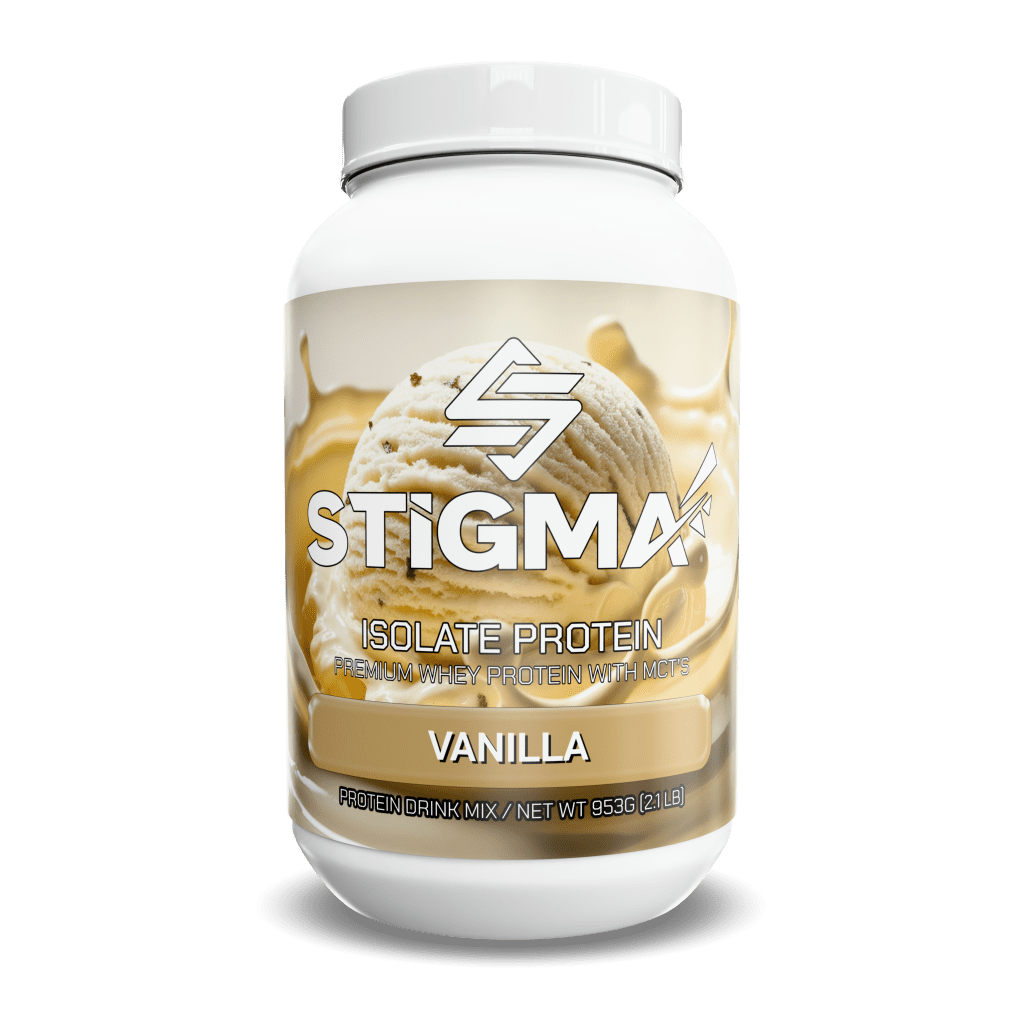
25g of clean protein per scoop
Premium whey isolate with low carb, low sugar, and a fully transparent label. Five flavors that don’t taste like chalk.
- 25g pure whey isolate
- Low carb, low sugar
- Under 1g lactose
- No proprietary blends
- 5 flavors, no chalk
- Easy-mixing texture
The blend question
Some products mix concentrate and isolate in the same tub. Brands do this for two reasons:
- Cost optimization. Concentrate is cheaper. Blending lets the brand hit a target price while keeping protein content high.
- Taste. Concentrate’s residual fat gives the blend a creamier flavor than pure isolate.
The science: blends work fine. The amino acid profile is essentially identical. The lactose content is somewhere between pure concentrate and pure isolate, which means lactose-sensitive users may or may not tolerate it.
The catch: many “blend” products are sold at isolate prices but are mostly concentrate. Check the order of ingredients on the label. If concentrate is listed first, you’re paying isolate pricing for mostly concentrate.
Honest blends (isolate first, concentrate second) at a fair price are fine. They’re a reasonable middle ground for people who want some of the digestive benefits of isolate but want to save a bit on cost.
What about grass-fed, organic, hormone-free?
A few quick takes since these come up.
Grass-fed. Slightly better fatty acid profile (more CLA and omega-3s) in concentrate. Mostly irrelevant in isolate because the fat has been filtered out. If you’re buying isolate, grass-fed is paying for a feature you’ve removed. If you’re buying concentrate and care about milk source quality, grass-fed is worth it.
Organic. Means the cows weren’t given certain antibiotics or fed pesticide-treated grains. Doesn’t change the protein quality. Worth it if you care about agricultural practices. Not worth it for the protein itself.
Hormone-free / rBGH-free. rBGH is a synthetic growth hormone given to dairy cows in some countries. It’s been banned in the EU, Canada, and other places since the 90s. US still allows it. If you’re buying US whey, “rBGH-free” is a real distinction. If you’re buying European whey, it’s redundant marketing.
None of these change what the protein does in your body. They change how the milk was produced. Pick based on your values.
What to look for on the label (regardless of form)
Whatever form you buy, the label tells you whether the product is honest:
Good signs:
- Single protein source listed first (whey isolate, whey concentrate, etc.)
- Specific protein-per-scoop number (25g, 30g, etc.)
- Short ingredient list
- Third-party tested (Informed Choice, NSF Certified for Sport)
- All ingredients listed with specific amounts
Red flags:
- “Protein blend” without breakdown of which proteins
- “Amino spiking” indicators (added free aminos like glycine or taurine to boost the protein number on nitrogen tests)
- Proprietary blends with no individual doses
- Mystery “enzyme blends” or “absorption matrices”
- Massive ingredient lists with 20+ items
- Cooking thickeners (carrageenan, xanthan gum, maltodextrin) as primary inputs
Amino spiking specifically is worth flagging. Brands add cheap non-essential amino acids to game the protein content on nutrition labels, since standard tests measure total nitrogen, not actual whey protein. A scoop that says 25g protein might actually contain 18g of real whey and 7g of free aminos that don’t build muscle effectively. Reputable brands publish third-party test results that break this down.
A note on what actually matters
I’ve spent 1,800 words helping you pick between three forms of whey. Here’s the thing nobody selling protein will tell you:
Your form choice is the bottom 5% of variables affecting your results.
The top 5%:
- Are you hitting 1.6-2.2g of protein per kg of bodyweight daily?
- Are you in a deliberate calorie surplus or deficit relative to your goal?
- Are you training with progressive overload?
- Are you sleeping 7+ hours?
If you nail those four, the whey form barely matters. If you miss those four, the right whey form won’t save you.
Pick the form that fits your stomach and your budget. Then go execute on the other 95%.
Frequently asked questions
Is whey isolate better than concentrate? For lactose-sensitive lifters, cutters, and people who care about clean macros, yes. For people with no digestive issues who eat at maintenance or surplus, the difference is marginal. Isolate has slightly more protein per gram, less lactose, and slightly faster absorption. Concentrate is 20-40% cheaper. Both build muscle effectively.
Is hydrolysate worth the extra money? For most lifters, no. Research shows hydrolysate beats slow-digesting proteins like casein for muscle protein synthesis, but does not meaningfully beat regular whey isolate. The price premium (often 50-100% more than isolate) isn’t justified unless you have specific gut issues, severe milk allergy concerns, or are a high-level athlete training multiple times per day.
Does isolate have less lactose than concentrate? Yes, significantly. Whey concentrate contains 3-7g of lactose per serving. Whey isolate contains less than 1g per serving. Most lactose-intolerant individuals can tolerate isolate without symptoms.
Can I take isolate every day? Yes. Daily whey isolate use is safe for healthy adults at typical doses (25-50g per day). The main long-term consideration is variety: getting protein from multiple sources (meat, fish, eggs, dairy, legumes) gives you a broader nutrient profile than relying on shakes alone.
Does whey isolate have lactose at all? Trace amounts, usually under 1g per scoop. For most lactose-intolerant people this is below the threshold that causes symptoms. People with severe lactose intolerance or galactosemia should consult a doctor before using any dairy-based protein.
Which whey is best for weight loss? Isolate, because it has fewer calories and lower carb content per scoop. The difference is small (20-30 calories per shake) but adds up over months of dieting. The bigger factor is total calorie balance, not whey type.
Does whey concentrate cause acne? For some people, yes. The current research suggests acne flares from whey concentrate may be related to IGF-1 response and trace hormones in the residual dairy. Switching to isolate sometimes resolves the issue because more of these compounds have been filtered out. Not everyone reacts this way.
Is whey isolate good for muscle gain? Yes. Whey isolate triggers muscle protein synthesis effectively due to its high leucine content (about 2.7-3g per 25g scoop, well above the 2-3g threshold needed). For muscle gain, any complete protein source hitting your daily total is sufficient. Whey isolate is convenient, fast-absorbing, and dose-controlled.
Can vegetarians use whey isolate? Technically yes. Whey is a milk byproduct, not a meat product. Lacto-vegetarians and lacto-ovo-vegetarians can use it. Vegans cannot, since whey is dairy-derived.
Keep reading
If you’re dialing in your supplement stack:
- Stigma Whey Protein Isolate: 25g premium isolate, low carb, low sugar, five flavors
- Stigma Pre-Workout: 8g citrulline, 325mg caffeine, transparent label
- Stigma Creatine Monohydrate: 5g pure micronized, 100 servings
- Stigma Hydration & Performance: Zero-sugar electrolytes with recovery support
- Related read: Creatine vs Pre-Workout: Which One (Or Both?)
- Related read: LMNT Alternatives: 8 Electrolyte Powders Compared
Sources and references
- Tang, J. E., et al. (2009). “Ingestion of whey hydrolysate, casein, or soy protein isolate: effects on mixed muscle protein synthesis at rest and following resistance exercise in young men.” Journal of Applied Physiology. Full text
- Tang, C., Xi, T., Zheng, J., Cui, X. (2025). “Chemical Properties of Whey Protein in Protein Powders and Its Impact on Muscle Growth in Athletes: A Review.” SAGE Journals / Natural Product Communications.
- Phillips, S. M., et al. “Dietary Protein for Athletes: From Requirements to Optimum Adaptation.” Journal of Sports Sciences.
- Schoenfeld, B. J., & Aragon, A. A. (2018). “How much protein can the body use in a single meal for muscle-building?” Journal of the International Society of Sports Nutrition.
- Devries, M. C., & Phillips, S. M. (2015). “Supplemental Protein in Support of Muscle Mass and Health: Advantage Whey.” Journal of Food Science.
Stigma Supplements builds fully-dosed, transparent formulas for lifters and athletes who care about clean macros. Our Whey Protein Isolate delivers 25g of premium isolate per scoop with low carb, low sugar, and no proprietary blends.
This article is for educational purposes only. People with severe milk allergies, galactosemia, or kidney disease should consult a doctor before using any whey-based protein supplement.
Grab the Stack